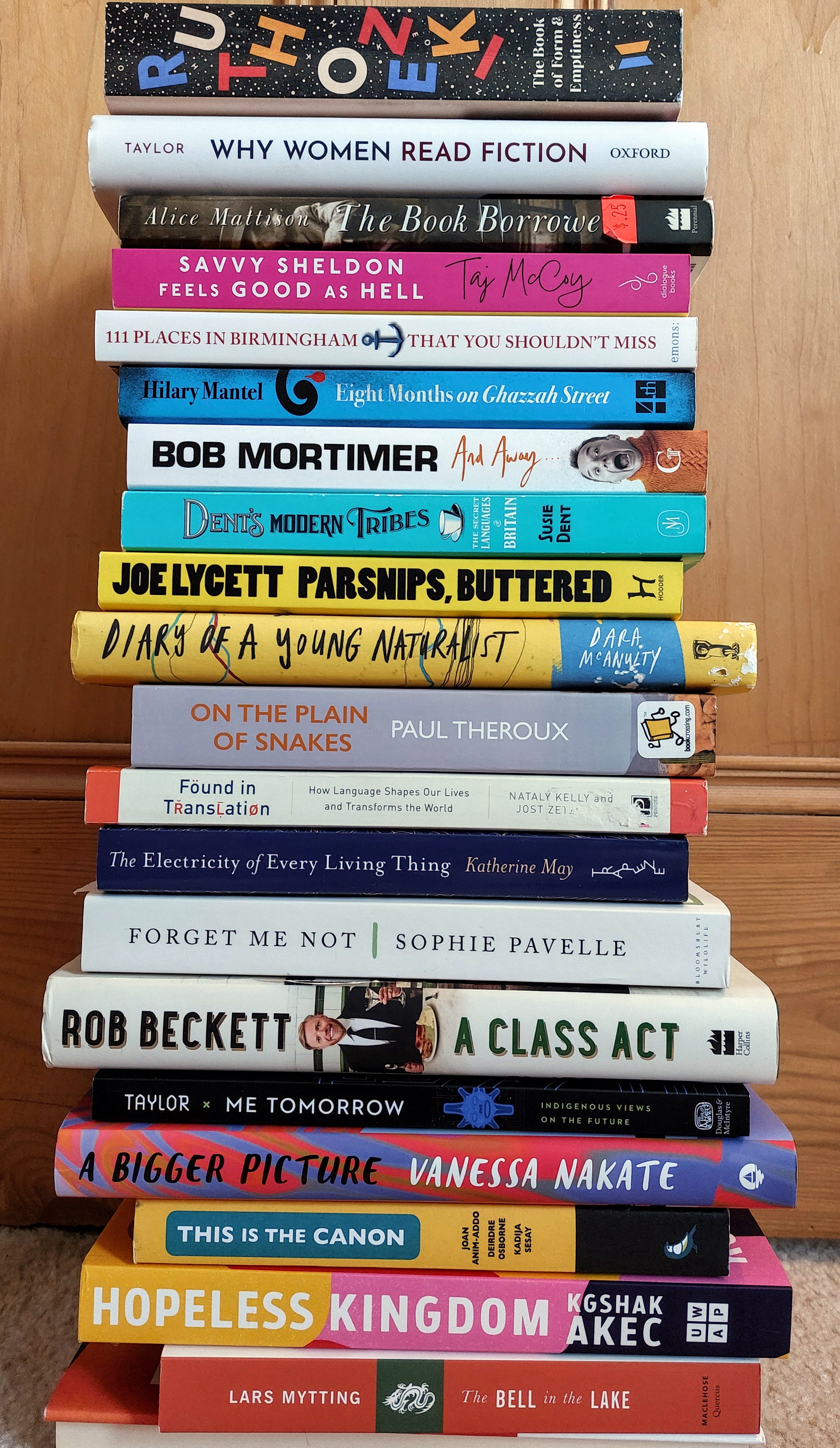
Book reviews – A Tale for the Time Being and Homecoming

2 Comments

May 2013 tbrToday’s reviews are of books that are both by female authors whose books I have enjoyed for some time now. They’re very different, but I will always read any book published by these authors, and know that I will have a reliably interesting and absorbing read. Ruth Ozeki has written three books so far, and I am going to revisit one of them in my Month of Re-Reading in July. Cathy Kelly has written eleven, which pleases me, as I think I’ve only read about six of them. One of these is literary fiction and one is what would probably be described as “women’s fiction” – both are good reads in their different ways.

Ruth Ozeki – “A Tale for the Time Being”

(27 April 2013)

I read this as my second readalong with Matthew, where he listened to the audio book and I caught up each evening with the paper book. In fact, because of some mild animal peril and slightly challenging themes, he did get further ahead of me than that and checked it was OK for me to read. It’s a good way to read a book, although it was a slower read than Capital, the first book we read in this way.

Ruth lives with Oliver and their cat on a remote Canadian island. When a bag containing a diary written by Japanese schoolgirl, Nao, washes up on the beach, an entire community gets involved as different expertises and knowledge sets are needed to interpret the barnacles growing on the bag or the languages used in the texts within it. Is this the first detritus from the Japanese earthquake/tsunami starting to appear via the ocean currents? Were Nao and her family caught up in those events?

Ruth feels a connection with Nao, and reads her diary to Oliver every evening (a nice echo of our reading process for this book). She tries to research the family and abandons her own writing, while Oliver tries to plant trees that the authorities say he’s no longer allowed to plant as part of an ecological artwork, and studies a new kind of crow that has appeared seemingly from across the ocean, too. Alternative sections of Nao’s diary and Ruth’s narrative, along with letters from Nao’s uncle, forced to become a fighter pilot in the Japanese Air Force in WW2 cover the personal, the philosophical and the historical, with forays into alternative worlds theory and Buddhist practice as well as Japanese popular culture. It’s an emotionally touching read in which you also learn a lot (like with all of Ozeki’s novels), although in this case it sometimes feels a little like the knowledge is there because Ozeki learnt it and wants to include it, rather than because it adds to the narrative or the background.

I felt that the power of the ending was undermined rather by the metafiction and almost “cleverness” that prevailed in the latter sections of the book. This led to a slight but marked sense of disappointment – I would like the author to have resolved things in maybe a more natural way. But it’s still a powerful, affecting, curious and surprising read.

Warning: the book contains some quite powerful scenes of violent and violating bullying at school and in the air force, an unexpected concentration on 9/11 and the Falling Man which may upset people, and some animal peril although this is not gratuitous and if you flick to the back of the book you can work out what happens there.

Cathy Kelly – “Homecoming”

(22 November 2012)

Kelly is a favourite light author of mine, and very much the inheritor of the “Irish women’s fiction with humour and reality” mantle passed to her by Maeve Binchy and Marian Keyes. In this satsifying novel, a cross-section of people live or arrive in a Dublin square, from a spinster teacher with a much younger sister through a cafe manager with a heart of gold and a hidden sorrow, an elderly American woman mourning her husband and re-reading her mother’s recipe book, to a minor celebrity who’s committed an indiscretion and needs to hide at her aunt’s house for a while. They are all healed by love, patience, sensible advice and the odd scrap of romance. Satisfying, funny, heat-warming – an easy read but well written and expertly crafted: happy endings don’t always come and when they do they have to be earnt, and it’s a great read for the exercise bike or the wallowy bath. Sometimes you can’t get better than that.

————-

I’m currently reading an excellent biography of the diarist and recorder-of-matters-Bloomsbury, Frances Partridge, and a slightly indigestible PhD printed directly as a book on Iris Murdoch. What are you reading at the moment?

Book reviews – Mystery Horse and A Glass of Blessings (and one just in …)

8 Comments

May 2013 tbrI’m hacking through Mt TBR quite briskly at the moment, although those two large volumes from the other day aren’t helping hugely, and I just moved my Great British Sewing Bee book upstairs, too (yes, I am going to read it, I didn’t just buy it to get it signed!). So I’ve got two novels to tell you about, both by writers whose books I’ve read many times before, and one a re-read. And yes, a small confession, too, but it really does NOT “count”, I promise. Read on to find out why (not)!

Jane Smiley – “Mystery Horse”

(29 September 2012)

This is the third in Smiley’s series featuring young Abby and the horses on her father’s farm. They’re interesting, because they’re as much about her friendships and family as they are about the horses, and they’ve also got a religious angle, in that her family belong to a very small church and at the moment she goes there too (I don’t know if this will change in subsequent volumes). They are quite big and satisfying books, with the plot moving along nicely in each one, and enough reference made to previous events that you can feel happy to be reading a series, but they do stand alone, too.

In this instalment, Abby “buys” a beautiful grey horse whose mysterious owner has died suddenly. It’s nothing to do with the horse, but he’s left abandoned, with no one to pay his boarding fees and no one to claim ownership. So, Abby takes him on and is just starting to learn how he ticks when disaster strikes and she’s unable to ride. As if this isn’t enough, an incident at Church threatens to decimate the congregation, and Abby feels like she’s being blamed, and then some ghostly happenings start up, triggered or increased by the appearance of a small (and exquisitely described) kitten at the house.

I’m not sure that the ghost bits worked that well. There was a twist, as you’d expect, but it didn’t really explain things at all, either in terms of explaining them away or in terms of what it’s all about if there is a ghost. That was the least satisfying bit of the book for me (but then I don’t like ghost stories much) although it was well woven in to the plot, with Abby’s friends sharing their own tales. But apart from that, it’s a good read, and I was pleased to see that books four and five will be along shortly. I wonder if pony books are as compelling to write as they are to read!

Oh – and don’t worry – nothing bad happens to the kitten! I always want to know that kind of detail …

Barbara Pym – “A Glass of Blessings”

(Bought 1990s – date not written in!)

I have to say straight off that this isn’t my favourite Pym novel. Sorry! I like the ones featuring anthropology and librarians, or mad offices, or both, best – so I enjoyed last month’s read, “Less Than Angels“, which some other people in the LibraryThing group that’s reading all of Pym this year weren’t so keen on. For this one, we’re almost in Elizabeth Taylor territory, with the heroine, Wilmet, one of those ladies who doesn’t really have quite enough to do, living with her husband and his mother in comfort, with old friends and the time to indulge in the odd crush and light flirtation. She’s a vulnerable and rounded character, but not a very identifiable-with one, and normally this doesn’t really bother me, but it leaves a sort of space in the heart of the novel.

There are many of the usual Pym accoutrements, of course: female friendships, tolerated pink husbands, churches and church houses, timid mousy ladies and overbearing mothers. There are also satisfying references to previous books scattered liberally throughout the story, and in fact one character in particular rather intrudes (I won’t say more than that for fear of adding a spoiler). I didn’t have many postits out in the garden with me where I read much of this book, and had to split them into smaller and smaller shreds as I noted references to Rocky Napier from “Excellent Women”, Archdeacon Hoccleve from “Some Tame Gazelle, Julian and Winifred Malory from “Excellent Women” and Prudence from “Jane and Prudence”, and there’s a reference to one of Catherine from “Less Than Angels”‘ stories, and speculation as to her character, as well as others whose postits surely fell out in transit. In fact, this seemed to be my favourite bit of the book, although there were some delightfully waspish and eccentric chaps associated with the church who raised a chuckle or two, and Wilmet’s “disappointment” (hardly enough to be an “unpleasantness” is subtly and well done.

In the end, nothing really happens, there are a few plot resolutions and Wilmet and Rodney will perhaps find themselves in a rather new situation. Maybe they’ll find themselves living next door to some anthropologists in a future book. Just because this isn’t my favourite Pym novel doesn’t mean it’s not a good novel – it’s wry, clever, witty, perceptive and atmospheric, of course.

A new acquisition

May 2013 bello1So, when someone connected with a new imprint that’s reviving out of print novels and offering them in print-on-demand and electronic versions contacts you because they’ve seen you discussing a particular author, and they offer you a choice of novels to have sent to you, and you choose the one that you don’t yet have and haven’t in fact read, but have promised to a group to read later in the year, that doesn’t “count”, right?

So in that case, this nice print-on-demand copy of Barbara Pym’s “Quartet in Autumn” doesn’t count in terms of books in and is perfectly acceptable. Well, whatever, it’s got a nice understated but well-designed cover and it looks OK to read inside and it was very kind of Pan Macmillan to send it to me – thank you. Although it doesn’t come up in the reading schedule until later in the year, I may well try to squeeze it in before the Barbara Pym Conference in July, so watch this space for a review.

May 2013 bello2And here’s some information from inside the book about the Bello concept. You can find out more from their website.

Book reviews – The Diamond Queen and Why We Run

2 Comments

May 2013 tbrTwo non-fiction books to review today, but rather different from one another, so April’s happy pairings were obviously a fluke.  But both good reads in their different ways!

Andrew Marr – “The Diamond Queen”

(13 September 2012)

Very much NOT “The book of the TV series”, as Marr states in the introduction, this is much more, and different, concentrating more on background, history, precedent and administration than last summer’s telly offering, which featured more of Princess Beatrice in the Queen’s life-size dolls’ house, etc. As reading a book is supposed to be more satisfying than watching a few hours of TV (isn’t it?), this was how it should be, and the book was fascinating.

There is lots of detail about the monarchy in the 20th century and, indeed, its relatives around Europe. This gives an excellent background to both the rituals of the current monarchy and the way the Queen reacts and behaves. It is a little bit hagiographical – but Marr is careful to point out that he observed the Queen closely during her public engagements and could not fail to be impressed. I am by no means a Royalist, but I did find the descriptions of her commitment to her role, shyness at public speaking and care for her people quite moving. I also liked the odd sign of cheek and liveliness most amusing: apparently the Queen and Prince Philip go driving around London in a nondescript car from time to time, still.

I read this at the same time as a friend reading it on Kindle, and I think it would have been a shame to read it without the pictures: it’s fairly lavishly illustrated with well- and lesser-known photographs and a set of pictures of the official portraits (including one featuring a corgi which bears a striking resemblance to one of our cats).  It’s written with care, in that Marr style with which we’re familiar from both his TV series and his other books: slightly dry and wry and more conversational than one might expect. All of the family scandals are brought out and examined (which does undermine the chronological structure of the book at times) and he’s obviously not a huge fan of some of those associated with the Royal Family. I found the discussions of the various Prime Ministers and what they said about their weekly audiences with the Queen, and the clarification on how exactly Blair overstepped the mark when talking about these in his own autobiography, the most interesting part of what was a wholly interesting and satisfying read.

Robin Harvie – “Why We Run: A Story of Obsession”

(13 September 2012)

Second in a bunch of books bought at the Book People shop on the local High Street – and I don’t think I’d even been to the dentist on that occasion. This is a dangerous book to read if you’re contemplating extending your half marathon training to see how far you can run (building up gradually) and then considering a marathon. Or a good book. I’m not sure.

Harvie had done a few marathons when he decided to join the rather alarming world of Ultra running – running distances longer than the 26.2 mile classic marathon. He sets his sights on the Spartathlon, oddly enough taking place in Greece, but does a lot of interesting races in between, decides fell running is a bit too scary, trains maybe a little too hard and obsessively, worries his wife and worries himself that he’s running away from issues in the family. All of this is set amongst a useful if slightly too well-known to someone who’s read a few long-distance running book) potted history of the marathon and beyond, references to other great books on the topic from Haruki Murakami (“What I Talk About When I Talk About Running“) and Richard Askwith (“Feet in the Clouds”) among others, and some amazing, visceral descriptions of his own long training runs or race attempts.

There was no greater end than that which this journey was satisfying, although there were plenty of other things I could have spent the last twelve months doing that would have been infinitely more pleasurable. (p. 257)

These passages are the stars of the book and really get into the nitty-gritty of what it feels like to be a distance runner. They inspire empathy, wincing and the desire to emulate his trials and achievements – after all, pretty well anybody can train for a marathon and there’s a joy in pushing yourself past your limits (he makes an interesting point about it being fair enough to praise the person who only ever runs one marathon because that is the pinnacle of their physical achievement, but if someone does more than one, they can probably do a bit more – do other runners agree with this?). His descriptions of attempting the Spartathlon are uncomfortable but unforgettable reading. Did he make it to the end? You’ll have to read the book to find out!

Oh – and there’s a quotation from Iris Murdoch on page 202, about attention teaching us how to observe things without greedily appropriating them for ourselves”, although this is tantalisingly not referenced. But one for my friend, Pamela, who likes to collect references to IM in what we read!

Book review – Joe and the Hidden Horseshoe plus two more acquisitions

1 Comment

May 2013 1I was kindly sent Victoria Eveleigh’s new pony novel by her publishers, Orion, as I’ve read, enjoyed and reviewed her Katy books and A Stallion Called Midnight. Like the Katy books, the Joe books are going to be a trilogy, so there’s room here for enough character development and background story to make for a satisfying set of reads.

As I’ve said before, Eveleigh’s books are very much of the old school of pony book. No talking horses or fairy dust; any magic is conveyed through the joy of the relationship between horse and rider, and familiar themes like  moving to the country and hoping to get some riding in are subtly updated (here, Joe is convincingly thrown into despair by the lack of an internet connection) and also slightly subverted (in this book, it’s Mum who’s most excited at the possibility of an equine purchase or two). As Eveleigh herself did, and explains in a nice note at the back of the book, I grew up reading classic pony books that featured girl and boy main characters – My Friend Flicka and the Black Stallion books being just two, and as Joe opines in the book, where do all the male jockeys, eventers and police riders come from if no boys ride? I’m not sure that this question is answered in this book, as the pony world is a fairly female one, although we have a nice male role model in the person of Chris, the farrier.

In fact, the role models are nicely done, with an older, Romany woman providing pony lore and quiet support as well as Chris and some other characters. There’s a good amount of information on various horse stuff which flows naturally out of the story rather than being bolted on, including some interesting up to date thinking on “barefoot horses”. There’s also a purposeful blindness to colour which extends across horses and people (and provided a twinge of recognition as the phrase “A good horse is never a bad colour” which was borne out by the mention in the afterword of Mark Rashid, whose book of that name I read and reviewed recently).

As with her other books, Eveleigh writes excellent young people as well as convincing horses and riders. Joe’s worries over having to “make” friends as opposed to growing up with them is treated well, and his assumptions are undermined. The use of his hobby of Aikido is inspired, as it allows some gentle lesson learning and introduces another gentle and positive male role model in the shape of the Aikido sensei in the local town. The relationship between Joe and his younger sister is also very well drawn and rounded, with all the ins and outs of sibling rivalry and protection, and some interesting plot developments.

There’s a lot to like in this book, and I’m very much looking forward to the sequels to this story. This book could be enjoyed by boys and girls. I was a little unsure about the mix of “YA” style typeface and “gentler” looking boy on the cover, but I think this makes it appeal to all sorts of readers (and it’s nice that the horses match the horses in the book, which doesn’t always happen). Oh, yes, and adults, too!

If you want to know more about the author, she has a lovely website, and there’s an interview that she did with me about her writing on my other blog, too.

May 2013 2A couple of other acquisitions before I go. We were in the supermarket the other day when I saw these two. And then the “kitty” owed me a tenner over the purchase of some cheese over the internet (don’t ask … in fact do ask, and watch this space for a post about cheese coming soon!) and so a newspaper and two books had me all paid back and neat and tidy. And they don’t count, right … because I have read all of Marian Keyes’ books and I have been wanting to pick up Clare Balding’s autobiography for ages …

Book reviews – Letters of an Indian Judge and The Glitter and the Gold

Leave a comment

Apr 2013 TBRI didn’t really plan for my new, longer, reviews to pair up non-fiction books, novels and now memoirs (or should I say, “memoirs”), but it’s quite nice and tidy that it’s happened that way, isn’t it? And with just a little preparation, I’ve managed to sustain writing these longer reviews (and fitting them into my notebook, too) – do you like them? Are you finding more to read and enjoy, with a bit more about the content of the books as well as my feelings about them? I hope so, but do tell me!

Anyway, here are my last two reads of April. Watch out for my May State of the TBR (not too bad, actually, thank you) and Upcoming Reads post which will be coming soon – I’ve got a lot of reading projects to get through next month so hopefully won’t acquire toooo many more …

“Letters of an Indian Judge to an English Gentlewoman”

(09 September 2012 – from Bridget)

The last of my books from Bridget, and this was rather an intriguing one. It’s a set of charming letters – one half of a correspondence – purporting to have been written over the lifetime of an Indian civil servant as he rises through the ranks to become a judge, taking in the sweep of Indian and Burmese history, first published in 1934 so presumably the sweep of history is up until the early 1930s. We get history and social change but seen through the lens of this one side of a rather touching set of letters between this judge and a lady who was once kind to him at a party, including the growing connection between their families. There’s an odd little note in the front of the second edition, the one I have, saying that this is non-fiction and published as such, but that there has been a furore over the book with it being attributed to an author called Dorothy Black. Now, I haven’t had time to look into this, but it does seem a little staged – there are so many coincidences, the writer’s son being employed by one of his own early employers, the connection between the oldest sons of the two families … It doesn’t spoil what is a very nice – if oddly symmetrical – book, which is rather moving in parts around the situation of women and the high infant mortality (although here there seems an odd mix between Hindu and Muslim practices which surely wouldn’t have happened). So, a good read, and a conundrum.

Maybe one of my readers has read this and knows more – do share in the comments if you do!

Consuelo Vanderbilt Balsan – “The Glitter and the Gold”

(13 September 2012 – The Works)

Real memoirs this time from the pen of the erstwhile Duchess of Marlborough, shipped over to England from America and married off to a Duke, bravely dissolving their unsuitable marriage and going through rather a lot to end up marrying the love of her life. But it’s more than an emotional journey: it’s a portrait of the British aristocracy in a time of immense change between the First and Second World Wars, with Consuelo trying to conform to the stuffy rules, not knowing anything else but blind obedience, then breaking out of her shell as societal changes allow her to, taking up really useful (rather than dabbly and silly) charity work to help the wives of prisoners and unmarried mothers, agitating for women’s rights and giving over her London property to meetings and social organisation. She writes well and clearly, and is affecting rather than affected. You get a good sense of what it was like to be thrown into this rather alien world, and her allies such as her cousin, Winston Churchill as well as royal and aristocratic figures of the day.

The book has a nice introduction by her granddaughter, explaining how distant the life of someone born in 1877 is from her own, and lots of good pictures, but it breaks off rather suddenly in 1940, which is a real shame. There’s a palpable love for France that shines through, and a complicated life and background is made clear and enjoyable to read about – interesting and informative indeed.

——

That’s April done – not too shoddy at all on the reading volume front, and I’m part way through two very interesting (and different) books that I’ll tell you about soon. What was your favourite April read? What’s coming up for you?

Business book review – Business Planning for Editorial Freelancers

Leave a comment

Product DetailsLouise Harnby’s book, “Business Planning for Editorial Freelancers” is a must-read for anyone considering going into this line of business. In fact, there is a great deal of useful general information in the book that would be useful for anyone looking to start their own business.

The book is packed with useful advice on working out what you want to do, formulating a business plan, building a customer base, networking, using social media, etc. It’s peppered throughout with real-life examples from a handful of other editors, who are working in fields as diverse as genre fiction editing, STM publishing and academic articles, as well as Louise’s own experiences and some longer case studies at the end. There’s a great resource guide with loads of links to useful blogs, pages and reference materials (I was chuffed to see a link to my blog in the resource guide, which I hadn’t expected!).

Although I’m obviously an experienced editor (etc.) who has been running a business for some time, I found it useful for two reasons. One, it’s always gratifying to know you did the right thing when you started out, and indeed I have done much of what is recommended here. Two, I learned a few things, which is always nice, specifically about some editing software that makes the job easier (which I will hopefully be getting hold of and reviewing on here at some stage), and about how to embed downloadable pdfs into your website. It’s never too late to learn something new!

There was lots more to recognise, too, such as the emphasis on other editors being colleagues, not competitors, and the advice to use what you’ve learned in your previous jobs and life experience to deepen and broaden your offering as a freelance editor. I also realised how lucky I was to come into the work having learnt my trade in various jobs in the past, and how lucky I was to build the business pretty much by word of mouth and advertising on one or two sites, plus using social media. Things can be a lot more daunting than that, and I appreciate how lucky I’ve been that everything came together at the right time.

As regular readers will know, I’ve written a book about starting your own business myself recently. I think this book and mine complement each other very well – this is about hard facts, research and the resources you need to get there, whereas mine is more a collection of experiences and lessons learned along the way, along with coverage of other areas such as what to do when you’re ill and what to wear in the home office. There’s also a great deal of information about training courses in editing and proofreading and the professional organisations, as befits a book published in association with the Publishing Training Centre. So I’m not shooting myself in the foot by shouting loud about how very good and useful this book of Louise’s is: it’s excellent and I wish it had been around 4 years ago when I was setting up Libro. I will certainly recommend it to new editorial colleagues and more experienced colleagues who might want to pick up additional information on training, networking or social media, for example.

More information about the book on Louise’s website, which includes links to the various places where you can buy the book.

————

Note: the author kindly sent me an e-copy of this book to review.

Book reviews – Get Ready for Battle and Sapphira and the Slave Girl

2 Comments

Apr 2013 TBRApril’s reading moves on apace with two more good works of fiction. In the photo of my TBR, I’m now on the last two books before the big blue one, although to be fair, more books have come on board since the picture was taken. I am winning the battle, though, as the front shelf is still not as full as it was at the beginning of this month. It’s a pleasant battle to be winning, too, with some real corkers read so far this month.

Ruth Prawer Jhabvala – “Get Ready for Battle”

(09 September 2012 – from Bridget)

A novella focused on an extended family in India and the conflicts within the immediate family, the extended family and the society beyond the family – all of which are scenes for the battle mentioned in the title. Gulzari Lal is in effect a capitalist patriarch, bringing his slightly ineffectual son, Vishnu, who craves both glamour and simplicity (and, when it comes to it, a quiet life) into his business. Sarla Devi is Vishnu’s mother, and still Gulzari Lal’s wife, but she lives in poverty at her brother’s house, trying to do simple good in society. This in turn is contrasted with the “social work” of the society wives and the selfish hedonism of the young business wives, and further contrasts are provided between the almost-socially acceptable mistress and the almost-prostitute dancing girl who are connected to the brothers-in-law.

Not much actually happens – the plot is loosely draped around the idea of a slum clearance that affects all of the groups of characters – but we are treated to a psychological examination of all strata of Indian society and all types of family member, and their interactions and interfaces, both good and bad. The mother’s actions in originally separating herself from the family are not, perhaps, explained enough, but the portrayal of the daughter-in-law and her lower-class friend and the complicated nature of their friendship and respective relationships with Vishnu are masterfully done, as we would expect of this author.

Willa Cather – “Sapphira and the Slave Girl” (Virago)

(09 September 2012 from Bridget)

This is the penultimate of the books passed to me by Bridget, and what a batch of treats they have provided. This one too, a nice original Virago green cover and an interesting and absorbing read. It’s a powerful novel set in 1850s Virginia, centring on a family that still owns slaves in an area where this is not illegal, but is frowned upon. The mistress, disabled by dropsy and trying to maintain the status quo amidst the potential collapse of the system, takes against her maid, Nancy, and sets out to destroy her. Sapphira’s daughter, Rachel, does her best to help all of the people in the neighbourhood, a bit like Sarla Devi in my previous read, putting society in general above her family in particular and motivated by a powerful need to redress the wrongs done by her mother, even if this has a shattering effect on her family.

It’s still shocking to read of people owning people, and the words used to describe those people made me uncomfortable, as did a strong underlying principle that emancipation can lead to excess and ruin, and that a society formed with strict places for all members should retain that system or risk complete anarchy – true small-c conservatism. But the powerful descriptions of the slave trade work against this slightly uneasy nostalgic attitude towards the old ways which is made explicit in the inconsistent treatment meted out to Sapphira’s slaves (we are also reminded in the introduction that this, Cather’s last novel, was a move to a discussion of her own family background, which sits these ideas more firmly in the authorial intent than in a fictional unreliable narrator).

All in all, though, it’s an absorbing story full of rounded human characters, if some flatter ones. The satisfying epilogue reveals the autobiographical nature of this novel, bringing the story up to date and providing a satisfactory resolution. Very evocative of period and place, and a good if sometimes uncomfortable read.

I’ve just finished one of the memoirs I was reading and have another on the go, so the next review post will be a pair of memoirs, after a pair of non-fiction books and a pair of novels. It’s worked out naturally this way, but I quite like it, as I like writing these slightly longer reviews (are you enjoying reading them? More than the shorter ones?). Then it’s more non-fiction with a big, fat biography of the Queen and her times by Andrew Marr and a book on running …

Book reviews – Mass Observation: First Year’s Work and Trailblazers

2 Comments

Apr 2013 TBRI’m barrelling through the TBR at the moment now that I’ve managed to arrange my work schedules a bit better so I have time to read. I also read a whole book the other day while recovering from a dentist appointment. Hooray for long swathes of reading – it was almost like being on holiday (apart from the wonky mouth …). Here are reviews of two excellent non-fiction reads. Expect more of these as I am entering a wodge of non-fiction on the TBR now (you can see them all after the Virago on the front of the TBR shelf in the picture).

Charles Madge & Tom Harrisson (eds.) – “Mass Observation: First Year’s Work”

(26 June 2012)

This is one of those charming Faber reprints with the squiggly pattern on the front and the interesting contents. I found out from who knows where that they were republishing some of the early MO books, and as a Mass Observer myself (we’re allowed to tell these days as it’s all about observing ourselves – and I’m proud to be Editor, 41) I have a particular interest in these, so I picked up this first one. They’re quite expensive for what they are, but I have never found any of them in a bookshop, so it’s worth the treat.

This is a reprint of a book originally published in 1938, with some charmingly slightly po-faced reports from early MO studies on smoking, pub-going and the pools. There is a long and interesting essay on MO by the sociologist, Malinowski, at the end, which bulks it out a bit and makes for a good read. The reports are full of statistics that go into such detail – at that stage they had full-time Observers who were able to collect huge welters of data which was turned into tables that reminded me of my exam-proven previous ability to create a table with borders and aligned figures, using a typewriter!

Anyway, I found it fascinating that the early emphasis was on observation rather than self-reporting, and this is why it is perhaps unsurprising that their careful review of newspaper coverage of MO finds criticism around spying! There are some event and monthly day diaries, one of which records the impressions of a variety of people involved in the Coronation, but we find neither the questionnaires or guided essays of the present day or the longer journals of the WW2 era.

It was also fascinating to read about the early impetus for MO and particularly the quotations from early Mass Observers on their reasons for joining the movement, which seem very fresh and reminiscent of today’s members and their own reasons for taking part. This will hopefully inspire me to complete my own reports in better time, especially since they don’t involve going to my local pub and counting the punters and how much they drink every night for a week!

Wyatt Thompson & Petronella McGovern – “Trailblazers”

(9 September 2012 from my friend Bridget)

The penultimate in a marvellous collection of books passed along to me by Bridget – thanks again! This is the fascinating story of the Australian 1956 Olympic equestrian team, the first such team to compete for Australia, and oddly competing at the Melbourne Olympics, six months before the Games and in Stockholm, owing to issues with quarantine in Australia at the time. So committed were the team to their cause that they came over to the UK 15 months before the competition as they were inexperienced in classical riding, especially dressage, and needed to gain experience they just couldn’t get at home.

There’s plenty of information on how and what they learned and their experiences in three-day eventing over here, good and bad. The story of the selection and the Olympics themselves is told in detail, and then the book fills in the story of equestrianism in Australia up until the early 21st century, with the characters we’ve met taking a strong leading role and giving real meaning to the term “legacy”. It’s also nice to come across iconic British riders like Pat Smythe in the story, and the horses are as important as the riders, with real sympathy for injuries and losses for other teams, and detail about the different mounts of the Australian team and their rivals.

A lovely bit of social and sporting history, well and competently put together for the novice or expert reader (I mean novice or expert in things equestrian, of course), with plenty of primary materials and photos and some lovely reproductions of paintings. I’ll admit that this is not for everyone, and I wonder how many people I lost at the second sentence, but this was a real treat for me!

Currently reading – well, I have a couple of novels to share with you next time, and I’m currently reading two very interesting memoirs, one set in India in the last days of the Raj and one set in the glittering aristocracy of the early 20th century.

And of course, I’d love to know … what are you reading at the moment?

Book reviews – The Golden Arrow and Illyrian Spring

11 Comments

Apr 2013 TBRI seem to be having a bit of a novel spree at the moment, although Mt TBR has a nice big wodge of non-fiction coming up. If I’d thought about it, I could have alternated a bit. But I like reading my books in acquisition order, so I’ll leave that be. Two excellent novels in this update – not similar in subject or location, but both very much products of the locations in which they’re set.

Mary Webb – “The Golden Arrow”

(16 June 2012, Oxfam Bookshop, Oxford)

Mary Webb is the great novelist of Shropshire country life. Her books can seem a bit overwrought, with the small figures of the local folk struggling against blind fate and cruel destiny, the Bible and the seasons woven into their desperate lives. They’re quite easy to parody, forming, of course, the main source for Stella Gibbons’ “Cold Comfort Farm”. But I find Webb to be firmly on the Hardy end of the Hardy-Lawrence continuum of my liking. Certainly, there are heaving passions and dreadful encounters with grim Bible bashing elders, but her books have a psychological detail and impact that is impressive, and this, her first novel, has that in spades.

We meet Lily and Deborah, contemporaries but contrasted in every way possible – fair and dark, sex and love, surface and depth, respectively. For all their differences, they end up entering into parallel relationships, Lily with Deborah’s somewhat stolid brother, Joe, and Deborah with the exciting blond newcomer, Stephen. Ah, yes, the incomer in fiction – where would so many stories be without them. And here he is, breezing in, asking questions of Deb that he really ought not to ask, and showing his unsuitability from the very start by his nervousness and discomfort around nature (shades of Hardy and the attitudes to Egdon Heath in “The Return of the Native” here). Hearts are ready to break, and all this is played out against the slow turning of the seasons and the pull between the landscape symbols of the white cross-like signpost and the huge brooding outcrop that forms The Devil’s Chair, and against the love of families, and the traditions of countryside myth, magic and community.

Such an engaging book. It was a page-turner right to the end, setting up the rivalry between the two girls expertly and twisting the reader into a dread of something terrible and doomy which always seems to hover just around the corner. It’s  a masterful portrayal of depression, too, although it’s never given this name, and of the love between parents and children. An absorbing, uncompromising read.

Ann Bridge – “Illyrian Spring”

(22 June 2012)

Lots of people I know had been raving about this one, and when I found out that it was set in Dalmatia, a part of what is now Croatia which I have visited and loved, I splashed out on the pretty newly reissued version (it’s done by Daunt Books but could quite easily be a Persephone or Virago). I was expecting it to be pretty darn near perfect, and really I can’t think of any criticism I could make of it. It’s charming and absorbing, with lovely characters but a moral and truth-seeking core that supports it well. We meet Grace, aged 42 and mother of three, fleeing in the 1930s from the family that has started to scare her and make her nervous. She feels that things might have gone irreparably wrong between her and both her husband and daughter (and in the former regard, a tiny chime of anti-Semitism made me wince early on and worry for my liking of the book, although it was brushed away by the author), and basically goes into hiding in Europe, moving from Venice to Split and then to Dubrovnik. Complicating matters somewhat, she falls in with a mysterious young man; while they are both painters, which is fine, a crisis soon arises which is only really resolved by a series of comical and charming coincidences which you can deliciously see coming from a fair way off. And the ending is nicely done, with some changes to the wife who Walter has grown comfortable with, some possible new blossomings of careers and romances, and some reassessments all round.

The modes of discourse are interestingly done, with Grace’s sections simply told, contrasted with her daughter’s slangy, bright letters to a friend and some curious interludes of Socratic discussion with a middle-aged German bachelor which are curiously reminiscent to me of some articles in a 1940s encyclopedia I have, in which a young brother and sister are instructed about the workings of electricity, the sewerage system, etc. (this is not to the novel’s detriment: it gave me a cosy feeling).

The sense of place is palpable. I didn’t much go for Dubrovnik when I visited – too touristy and it reminded me of nothing so much as Canterbury – but the descriptions of the city, the nearby villages, Split and Venice are beautifully done and hugely evocative. I was only slightly disappointed that they didn’t visit the coast and islands in between Split and Dubrovnik (the bits I know), but that is a very minor quibble.

A lovely, satisfying book, well worth the wait between purchase and reading, and well worth re-reading in the future. Thank you to all who recommended it to me!

—-

Coming up I have the aforementioned non-fiction delights, including a reprint of the first year’s report of Mass Observation and one on Australian Olympic equestrianism. And have you noticed that these reviews were a bit more full than the ones I usually jot down? I’m going to try to be a little more expansive from now on (when I have the time) – do let me know if you like the new style. And a tiny plug: I have published my new book, Going It Alone at 40, all about my first year of self-employment. It’s available from all varieties of Amazon. I’ll be doing a big fancy launch once I have the cover image sorted out and a few reviews …

And of course, I’d love to know … what are you reading at the moment?

Book reviews – Less Than Angels, The Householder and Sense and Sensibility (and a confession)

7 Comments

Apr 2013 TBRThree excellent novels to start off the month in style, all rather different, with different settings and characters, but all written with that clear and slightly satirical style which I do like in my novels. And then there may be a small confession at the end …

Barbara Pym – “Less than Angels”

(29 December 1994)

We’re in the academic world of an anthropology institute this time, where students train towards (hopeful) distinction in The Field and elderly academics guard their dusty trunks of field notes like a lion guards its prey. Young Deirdre falls for a seemingly unattainable chap who has the glamour of someone who has been in The Field; we meet the impoverished students, Mark and Diggory; Esther Clovis has her starring role at last, after mentions in two other novels (and we are brought up to date with Mildred and Everard – again, I love this interweaving of previous characters into the narrative); and the rituals and customs of suburbia and academia are compared rather marvellously with those of deepest Africa that are deemed worthy of publication and study grants. There’s more “story” in this one, but just as much delicious detail and excellent characters, from solitary Catherine with her writer’s eye to a solid succession of Aunts.

Ruth Prawer Jhabvala – “The Householder”

(12 September 2012 – from Bridget)

More delights from the pile of books passed to me by my friend Bridget. This one is pretty well a novella rather than a novel, but so lovely and absorbing. Prem is in a new (arranged) marriage and feels like his wife’s a stranger – except at night, but then he feels guilty about that. He works as a teacher and is struggling there, too. As he and his wife negotiate the incursions of the outside world – their mothers, a party at the school, a foreigner who befriends Prem and their garrulous neighbours/landlords – they have their effect on the interior world of their marriage, and Prem’s wife is individualised and humanised in his eyes. Will the couple be drawn together into a unit after all? A simple story, simply and wonderfully told. If you like R.K. Narayan, you will love this author, and vice versa.

Ruth Prawer Jhabvala died on the day I read this book – RIP a great writer.

Jane Austen – “Sense and Sensibility”

(pre-1989 – another Penguin Classic with sticky-backed plastic cover)

My friend Ali and I have been reading some Austens in our Months Of Re-Reading in January and July but it somehow wasn’t enough to only read one every six months, so I was very pleased when Ali suggested this reading treat for the Easter holidays (her review will be up soon and I’ll link to it when it is).

So familiar even though I haven’t read this for ages, and complete with Student Liz pencil notes, the story of sisters, Elinor and Marianne, their love lives and their different approaches to life, love, husband choice, landscape and friendship based on their adherence to the concepts of sense and sensibility, respectively, is as captivating and absorbing as ever. Austen’s wry, clear eye is as satirical as it needs to be without tipping into parody (themes explored in Northanger Abbey, which I adore even as it does slightly tip over into parody, about the Romantic are stronger here than I remembered), and there is a cast of lovely characters as well as delicious villains like Lucy Steele. You know that almost everything will come out right in the end, but the twists and disappointments are real and affecting and the characters steal into your heart – even dear stuffy old Colonel Brandon.

Although the book has a moral heart and a lot to say about the appropriate way to behave (not necessarily matching the mores of the time), but is in no way preachy, but instead a joy to read. It’s a bit of a cliché to bang on about how “timeless” Austen is, but how can you say anything else about a classic which you can’t put down for the sake of the story, the characters and the wry asides?

A confession

Apr 2013 confessionIt was Matthew’s fault, maybe? Hm. He was back from his work trip abroad and I worked hard on Friday to put Saturday aside for him. He said he’d like to do our usual wander up the High Street. I went with him to all the shops (International Stock Warehouse of random smoke-damaged stock; the Free Zoo, aka the pet shop; Lidl for a pastry (for him)) but drew the line at Computer Exchange, and went to WHSmiths instead. Which had a clearance section.

This is a memoir of life on horrible camping trips in the 70s. I have never been camping – NO, THANK YOU! – but I did grow up in the 70s so I’m looking forward to this read in many months’ time when I get to it!

It’s on my wishlist and it was only £1 … as if my TBR wasn’t bad enough, however!

—-

Coming up on the reading front I have a Mary Webb Virago and then the excitement of reading Illyrian Spring by Ann Bridge, which I have in a beautiful edition and is set on the Dalmatian Coast, a beloved place for me. How exciting! I also have one more Prawer Jhabvala and then I’ll be hitting a rich seam of non-fiction for a while … What are you reading at the moment?

Older Entries

Follow

Get every new post delivered to your Inbox.

Join 1,851 other followers